Welcome to the Rabbit Hole
You don’t have to agree with us. We want you to have access to the truth and understand what’s happening, know where the information comes from, & make your own decision.
Understanding local politics shouldn’t have to be this complicated, but it is. You shouldn’t have to dig through years of board minutes, legal documents, and financial statements to know where your money goes, how it’s being spent, or who’s responsible in spending it.
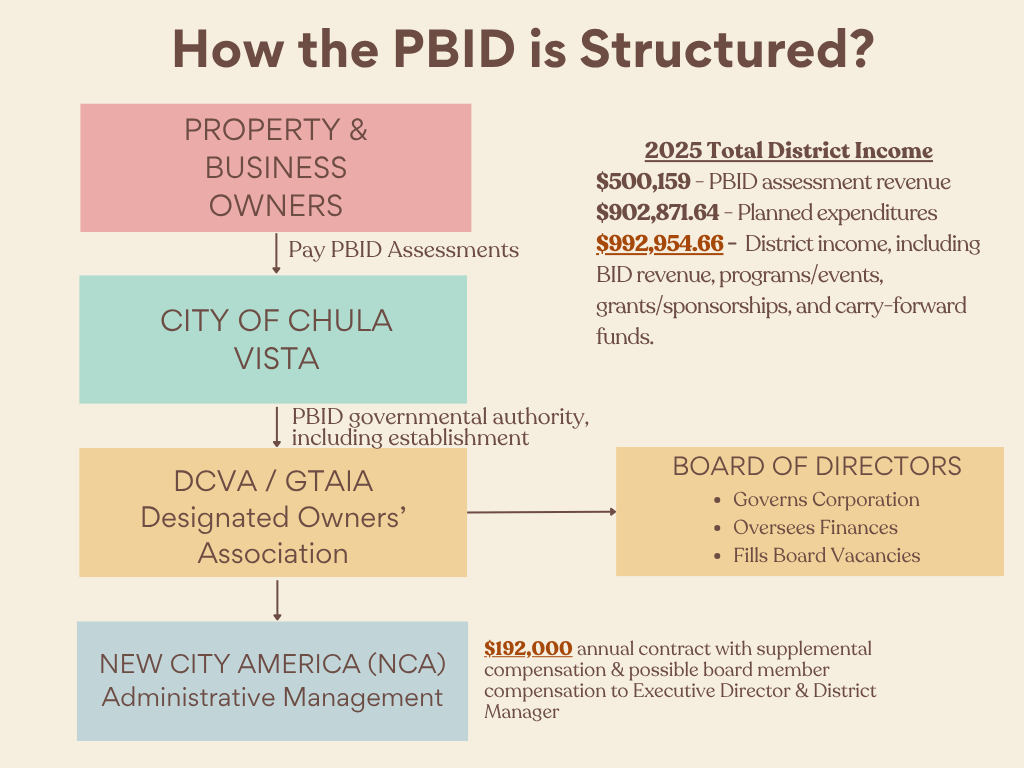
And yet, that’s exactly what’s happening in Downtown Chula Vista. The property owners and business owners pay into a collective fund that’s meant to service and improve a defined district, otherwise known as a PBID (Property and Business Improvement District). With a reported $992,954.66 in total district income, the City of Chula Vista granted The Downtown Chula Vista Association, formerly known as Third Avenue Village Association, or TAVA, as the PBID administrator. In 2021, TAVA hired a contracted management company, New City America, or NCA, to provide administrative management. NCA was already developing a reputation for their oversight in a few PBIDs in Southern California, specifically San Diego’s Little Italy.
Why is This Important?
DCVA is registered as a private nonprofit corporation, and is made of 14 Board of Directors, but the bylaws allow for up to 17 directors. As the PBID’s designated owner’s association , DCVA is responsible for administering the district’s activities and overseeing its finances. The Board of Directors governs the corporation, while DCVA contracts with New City America to provide administrative management services.
The question that caught my attention was, who is really in charge of the agency, the PBID, and the money? According to DCVA’s bylaws, the corporation has no members. Property owners and business owners within the district are not members with voting rights. Instead, the rights that would ordinarily belong to members are fixed in the Board of Directors.
That means property owners and business owners who are subject to the PBID assessment do not have a direct vote in selecting DCVA’s Board. Board vacancies are filled by the existing Board, giving the Board significant control over who joins its governing body.
And while the bylaws establish term limits, there are documented instances in which individuals have changed their Board titles and continued serving on the Board under a new term.
As of September 1, 2026, David Graham, Director of Economic Development for the City of Chula City, proposed to renew the PBID for twenty years; as opposed to the typical 10 year period California statutes states. It is unclear if the city has authority to modify the duration limitation listed in the California Streets and Highways Code.
What this site is & why it exists
Choose your journey
-
We suggest familiarizing yourself with the PBID:
The funded activities required under the management plan
The proposed 20 year management plan that includes an allowable assessment increase of up to 7% annual,
The public hearing to vote for the new PBID is a weighted vote, meaning the more property you own, the more votes you have, board nomination process,
The claims in DCVA’s annual reports to the City Council.
If you decide to go further down the rabbit hole, you’ll learn about the many discrepancies presented to the city council. For example, on August 25, 2026 and September 1, 2026 we spoke highlighted the assessment increase to 7%, and Director of Economic Development, David Graham, stated assessments have only been increased twice. Upon further review, we know the assessments have been increased three times, 2018, 2022, & 2025, Twice since New City America was hired in August of 2021.
-
We recommend learning about the DCVA and it’s structure, including how to request services covered by the PBID. As business owners, your representation is limited in a few distinct ways.
Board access is structurally property-owner centered.
The renewal vote is fundamentally a property-owner vote
The assessment can economically reach business tenant through their leases
Every section has a little door to go further down the rabbit hole just be warned, you may not like what you see, but know we are in this together.
For example, the former owners’ association, Third Avenue Village Association (TAVA), offered memberships to both business owners and property owners and held open elections for its board.
When New City America (NCA) was hired, the governance structure changed. A new private nonprofit organization was established, replacing the open election process with a nomination and appointment process. Under this structure, a task force identifies and recommends nominees to the Board, which then determines who will serve as property directors, business directors, or community-at-large directors.
-
As a community member it is important to know the current situation effecting small businesses. We recommend learning about the city’s role, specifically the Director of Economic Development, the City Manager, the City Attorney, & how the City Council members engage & vote.
We may not have a vote within the owners’ association, but we do have a voice with the City Council, particularly through our votes in local elections.
-
If you’re interested in the basics, the homepage provides an introduction to the issues at hand. You can also explore the history and timeline, from the first owners’ association and its open elections, to the transition to DCVA and the dismantling of its voting member structure, and how those changes have led to the issues we’re facing today.
Every section has an option to go further down the rabbit hole. And if you’re anything like me…you’re going to fall in and not know where you end up.
-
Read every section. We’ve intentionally linked supporting documentation including, detailed board meetings, financial records, news articles, bylaws, New City America’s contract, etc.
We also explore other contracts and PBID’s with New City America highlighting patterns in governance structures, supplemental compensation, increasing assessments, increasing vendor fees for events, increasing parking fees, etc.
Did you know